Showing posts with label SPORTS. Show all posts

Thursday, June 30, 2016

ARGENTINE PRESIDENT ARGUES MESSI TO CONTINUE WITH NATIONAL TEAM


Will that be Lionel Messi's last touch in international football? 
The 29-year-old Argentinian wizard announced his retirement from the international game right after his side lost the Copa America final to Chile on Sunday. In a fixture decided on penalties, Messi cut a disconsolate figure pumping his shot way over the bar and failing yet again to guide his side in a major tournament. 
The world's attention quickly turned from Chile's heroics in retaining their title to Messi's shock retirement. On Tuesday Argentina's President Mauricio Macri, football legend Diego Maradona and millions of fans around the world joined an ever-increasing chorus pleading the player to reverse his decision. "He has to stay because he still has playing days ahead of him," 
Maradona was quoted as saying by La Nacion newspaper online. "He will go to Russia in form to be world champion." Messi is widely rated as the best player in the world, but Sunday's loss was his fourth defeat in an international final for Argentina. The team has not won a major trophy for 23 years now. President Macri joined the calls for the Barcelona superstar to stay with with the national team. "He called him and told him how proud he feels of the national team's performance and asked him not to listen to the criticism," a spokesman for Macri told AFP by telephone. Argentine football 'disaster' The 1986 World Cup winner Maradona, 55, blamed Argentina's recent lack of trophies on the country's football association (AFA). He accused it of not supporting Messi and letting him take the blame for Sunday's defeat. "Those who are saying he should quit are doing it so that we won't see what a disaster Argentine football has become," La Nacion quoted Maradona as saying. Messi and the squad landed back in Buenos Aires on Monday evening after the tournament in the United States. Television cameras followed their coach but the players had yet to make any comment to the media. String of defeats Argentina were beaten 1-0 by Germany in the final of the 2014 World Cup and lost on penalties, also to Chile, in the 2015 Copa America final. Messi also tasted defeat with Argentina in the final of the 2007 Copa America. In this month's Copa semi-final win over the United States, he became Argentina's top international scorer of all time with his 55th goal. But after Sunday's final, his typical composure gave way to tears of frustration. "I've done all I can, I've been in four finals and it hurts not to be a champion," Messi told reporters.

Monday, June 27, 2016

MESSI RETIRES FROM INTERNATIONAL FOOTBALL WITH TEARS


Lionel Messi sensationally announced his retirement from international football on Sunday after Argentina crashed to an upset defeat against Chile in the final of the Copa America.
The heartbroken Barcelona superstar was distraught after missing a spot-kick as Chile snatched victory in a penalty shoot-out - Messi's fourth straight defeat in a major final while representing Argentina.
"For me the national team is over," the crestfallen 29-year-old told reporters.
"I've done all I can, I've been in four finals and it hurts not to be a champion.
"It's a hard moment for me and the team, and it's difficult to say, but it's over with the Argentina team."

Messi's dramatic announcement followed Argentina's third loss in a major final since 2014.
They were beaten 1-0 by Germany in the final of the World Cup in 2014 and lost on penalties, also to Chile, in the final of the 2015 Copa America.
Messi also tasted defeat with Argentina in the final of the 2007 Copa America.
Despite a glittering career that has seen him named Fifa World Player of the Year on no fewer than five occasions, Messi has often faced baffling criticism from Argentina fans.
Although universally regarded as one of the greatest footballers ever, he has regularly been criticised for his failure to land a major title in the colours of Argentina.
Messi's failure to match the achievements in the Argentina jersey of Diego Maradona, who single-handedly carried the team to victory in the 1986 World Cup, has often been held against him.
Maradona himself has often taken potshots at Messi, criticising him on the eve of the tournament for a perceived "lack of personality".
"He's a really good person, but he has no personality," Maradona said in Paris shortly before the start of Euro 2016.
"He lacks the character to be a leader."
Messi's bombshell decision comes after a gruelling season which was disrupted by injury last year.
He recovered to help Barcelona win the Spanish title once more and was relishing the prospect of leading Argentina to glory in the Copa America Centenario.
His commitment to playing for Argentina was reflected in his decision to fly from Spain to Argentina for a low-key friendly against Honduras shortly before the tournament, where he suffered a back injury.
He then returned to Spain to give evidence at his trial for tax fraud before jetting off to the United States to join up with his Argentina team-mates.
Although he was injured for his team's opening group game against Chile, he came on as a substitute in a 5-0 hammering of Panama to score a hat-trick in 19 minutes.
He then equalled Argentina's international goalscoring record of 54, held by Gabriel Batistuta, in the quarter-finals before setting a new mark with his 55th international goal in the semi-final win over the United States.

Lionel Messi Factfile


  • Name: Lionel Andres Messi
  • Nationality: Argentinian
  • Date of birth: June 24, 1987 - age 29
  • Place of birth: Rosario, Argentina
  • Club: Barcelona (ESP/since 2000)
  • International appearances: 112
  • International goals: 55
  • International debut: August 17, 2005, Hungary 1 Argentina 2


Honours


Club

  • Champions League (4): 2005-06, 2008-09, 2010-11, 2014-15
  • Club World Cup (3): 2009, 2011, 2015
  • Spanish Championships (8): 2004-05, 2005-06, 2008-09, 2009-10, 2010-11, 2012-13, 2014-15, 2015-16
  • Spanish Cup (3): 2008-09, 2011-12, 2014-15, 2015-16
  • Spanish Super Cups (6) 2005, 2006, 2009, 2010, 2011, 2013

International

  • World Cup: Finalist (2010), Quarter-finalist (2006, 2010), 15 matches, 5 goals
  • Copa America: Finalist (2015, 2007, 2016), Quarter-finalist (2011), 16 matches, 3 goals
  • Olympic gold medal (1): 2008
  • Under-20 World Cup (1): 2005

Individual Honours:

  • Ballon D'Or (5): 2009, 2010, 2011, 2012, 2015
  • Top scorer in the Spanish league (3): 2009-2010 (34 goals), 2011-2012 (50 goals), 2012-13 (46 goals)
  • Top scorer in the Champions League (5): 2008-2009 (9 goals), 2009-2010 (8 goals), 2010-2011 (12 goals), 2011-2012 (14 goals), 2014-15 (10 goals)
  • World Cup Golden Ball (1): 2014
  • Olympic player of the tournament (1): 2008
  • Under-20 World Cup player of the tournament (1): 2005
  • Top scorer at Under-20 World Cup (1): 2005 (6 goals)

Thursday, June 23, 2016

RONALDO SAVES PORTUGAL, ZLATAN BOWS OUT IN EURO 2016

zlatanbows
Christiano Ronaldo is back among the goals at Euro 2016 after scoring twice to send Portugal through to the round of 16 where they will play Croatia.
A Zoltan Gera half-volley put Hungary in front but Ronaldo set up Nani to fire in an equaliser before the break.
Ronaldo then scored a brace after Portugal had gone behind twice to finish the 6-goal thriller 3-all in Lyon.
Hungary progress as Group F winners, Iceland finished second after a dramatic 2-1 win over Austria with Portugal through in third place.
Iceland will now play England in the last 16.
Elsewhere, Zlatan Ibrahimovic ended his international career on a dissapointing note as Radja Nainggolan’s superb strike ensured Belgium progressed to the last 16 and Sweden went out.
The Republic of Ireland also made it through to the last 16 after Robbie Brady headed a late winner against Italy in Lille.
Belgium thus finished as Group E runners-up and will face Hungary in Toulouse on Sunday.
Sweden exit the competition with one point from three games in which Ibrahimovic failed to score.
The Republic finished third in Group E and will now play hosts France.

Wednesday, June 8, 2016

GOODBYE STEPHEN KESHI, THE HISTORY WILL REMEMBER YOU AS THE BLACK SUCCESSFUL COACH


The first time I met Stephen Keshi was in 2002. He was lying on a sun-lounger by a pool in a hotel in Bamako and I was one of about a dozen journalists crouched at his feet, eager for the views of the great centre-back turned assistant coach. The next time I saw him, four years later, he was fighting Emmanuel Adebayor on a bus in Cairo.
The last time I spoke to him was from a car park outside a warehouse in Johannesburg that, it turned out, stocked poles for erotic dancing as I interrupted my journey to the airport to find out whether he had actually resigned or was engaged in an act of remarkable brinkmanship.
Keshi, who died on Tuesday evening aged just 54, was a brilliant coach. He was a talker, a brawler and a politician. He had the thickest hide and deepest laugh of anybody at any Cup of Nations over the past two decades. His critics, of whom there were many, would point out that he liked money, and that he used football to acquire it, which is true, although he’s hardly unique in that. But he’s also the most successful black African coach of all time, one of two people to win the Cup of Nations as a player and manager, and the only black African to coach in the knockout phase of a World Cup.

Even from that first chat in Mali, it was obvious then that he had a bright future in management. He was intelligent and ebullient, forthright in his answers and, vitally for anybody working in Nigerian football, he visibly enjoyed the process of being questioned and of explaining himself.
Keshi had been a very fine central defender, winning titles in Nigeria and Ivory Coast before moving to Belgium with Anderlecht where he won two cups and a league title. In 1994, he was, in partnership with Augustine Eguavoen, the bedrock of the superb Nigeria side that won the Cup of Nations in Tunisia. He was 32 then and moved to the US, winding down his playing days while studying to be a coach. He maintained a house in California for the rest of his life.
His first steps in coaching came with Togo. In 2004 he took over a side that had only previously reached five Cups of Nations, never getting beyond the group stage, and led them to an improbable qualification for the 2006 World Cup. It was a miraculous achievement but, the following January, Adebayor was left out of the starting line up for Togo’s opening game at the Cup of Nations, a 2-0 defeat to DR Congo. There was unconvincing talk of an injury but as journalists waited in the car park for players after the game, we became aware of a ruckus on the Togo team bus. Looking up, we saw Keshi being restrained by Togo players, fist raised, trying to get to Adebayor.
Keshi, it subsequently emerged, felt he was owed some sort of bonus for the centre-forward’s move from Monaco to Arsenal.
Keshi involved himself in transfers, something that was true even in his playing days. When Nii Lamptey, after impressing at the Under-20 World Cup in 1989, fled the Ghanaian football federation to make for Europe he went via Keshi’s agent in Lagos.
He eventually left Nigeria for Belgium on a forged passport that claimed he was Keshi’s son.
Without Adebayor, Togo lost all three games at that Cup of Nations.
Inevitably, Keshi was sacked, replaced by the septuagenarian German Otto Pfister. Togo lost every game at the World Cup as well. But Keshi would have his World Cup. He had an unexceptional stint in charge of Mali, sandwiched between two other spells with Togo before getting the job for which he had always seemed destined.
Nigeria are the great underachievers of African football. Despite being the most populous nation on the continent and caring deeply for the sport, they had won only two Cups of Nations. They didn’t even qualify for the 2012 tournament. Keshi perhaps, had learned from the experience of his former defensive partner Eguavoen, a decent man overwhelmed by the job, battered by what is perhaps the world’s most demanding football media.
Keshi, right from the off, fought back. Nigeria press conferences usually involve a pack of journalists berating the poor man at the front in the tracksuit; the browbeating carried on, but under Keshi the roles were reversed. This was the Big Boss in action, smarter, tougher, funnier than anybody else in the room. But he was not without humour and his barbs never felt like bullying. He appreciated a joke.
For a couple of years the Second Captains podcast has used a hilarious sample of a charged exchange between Keshi and the BBC journalist Oluwashina Okeleji as one of its stings.
At the press conference in Rustenburg after Nigeria had beaten Ivory Coast in the quarter-finals of the 2013 Cup of Nations, the microphone was handed to the legendary South African journalist Mark Gleeson.
“Where have you been, big man?” Keshi asked (Gleeson is 6ft 10in). “I haven’t seen you in ages.”
“I’ve been covering the big boys,” came Gleeson’s reply.
For a fraction of a second, Keshi tried to look annoyed, but then his head rocked back in a familiar rumble of laughter.
Keshi had shown himself to be admirably independent. He’d infuriated many by calling up four players from the domestic league, and he had shown before the tournament that he was prepared to drop anybody he considered insufficiently committed. The old days of stars pulling out of friendlies and qualifiers at the last minute were ended. Nigeria went on to win the tournament, their first since 1994, and it was discernibly Keshi’s triumph.
Yet even in the hours after the final, the impossibility of the job was revealed as Nigerian Football Federation (NFF) officials approached the Zambia coach Herve Renard with a view to installing him in Keshi’s place. Keshi resigned, prompting my panicked call on the way to the airport, and the NFF was forced to back down. He led Nigeria to qualify for Brazil 2014, and there took them to the last 16 where they were a little unfortunate to lose to France.
His wrangles with the NFF went on and he finally left the job last year, having resigned on at least half a dozen occasions. His wife of 33 years, Kate, died last December and he has understandably had a lower public profile of late but there was still a sense that he had a lot more to give.
He could be awkward and obstreperous, and some of his involvement in transfer dealings was murky, but Keshi was, at international level, the finest African coach of his generation and he was fun to be around. Without his booming laugh, Cups of Nations won’t be the same.

Tuesday, June 7, 2016

POPULAR MMA FIGHTER DIES AT THE AGE OF 42


Popular mixed martial arts fighter Kevin "Kimbo Slice" Ferguson has died. He was 42. 
Slice was stricken at his South Florida home and taken Monday afternoon to the Northwest Medical Center in Fort Lauderdale, a spokeswoman for the Coral Springs, Fla., Police told Yahoo Sports on Monday. He later died.
Bellator president Scott Coker confirmed Slice's death in a statement:
"We are all shocked and saddened by the devastating and untimely loss of Kimbo Slice, a beloved member of the Bellator family. One of the most popular MMA fighters ever, Kimbo was a charismatic, larger-than-life personality that trancended the sport."
"Outside the cage, he was a friendly, gentle giant and a devoted family man. His loss leaves us all with extremely heavy hearts, and our thoughts and prayers are with the entire Ferguson family and all of Kimbo's friends, fans, and teammates."
Sgt. Carla Kmiotek of the Coral Springs police told Yahoo Sports no foul play is suspected. She said the department dispatched a team of officers to Slice's home because he is a public figure in order to control whatever crowd might gather.
"At 8 p.m. (ET) we received a call from TMZ," Kmiotek said. "Our communications department confirmed with Northwest Medical that he is there. We did not receive a police or EMS call from the residence. There is no foul play suspected and there is no investigation. It is being handled as a medical incident.
Slice burst into prominence a little more than a decade ago, when videos of his infamous street fights were viewed millions of times on YouTube. He initially signed with Elite XC and drew huge ratings for his fights on CBS.
In 2009, he signed a deal with the UFC to appear on Season 10 of "The Ultimate Fighter." He was eliminated by Roy Nelson in the opening round, but appeared on the season finale and defeated Houston Alexander. He fought once more in the UFC and was knocked out in the second round of UFC 113 by Matt Mitrione.
Slice fought his last two fights in Bellator and drew huge television ratings for each. He defeated Ken Shamrock at Bellator 138 on June 19, 2015, and Dhafir Harris, aka Dada 5000 at Bellator 149 on Feb. 19. However, Slice tested positive for an anabolic steroid following that fight and the victory was turned to a no contest.
He had been scheduled to rematch James Thompson at Bellator 158 in London on July 16. Slice was 5-2-1 as a professional mixed martial artist. He also had seven pro boxing matches and was 7-0 with six knockouts.

Saturday, June 4, 2016

LEGENDARY BOXER MUHAMMAD ALI DIES AT 74

Muhammad Ali, the eloquent, colorful, controversial and brilliant three-time heavyweight boxing champion who was known as much for his social conscience and staunch opposition to the Vietnam War as for his dazzling boxing skills, died Friday.
Ali, who had a long battle with Parkinson's disease, was taken to a Phoenix area hospital earlier this week where he was being treated for a respiratory issue. He was 74.
Once the most outrageous trash talker in sports, he was largely muted for the last quarter century of his life, quieted by a battle with Parkinson's.
View gallery
.
Born Cassius Marcellus Clay Jr. on Jan. 17, 1942, in Louisville, Ky., Ali learned to box after his bicycle was stolen when he was 12 years old. When young Clay vowed to "whoop the behind" of the thief, a local police officer encouraged him to learn to box to channel his energy.
He would go on to become known as "The Greatest," and at his peak in the 1970s was among the most recognizable faces on Earth.
He was known for his tendency to recite poems while making predictions about his fights – "Float like a butterfly, sting like a bee. The hands can't hit what the eyes can't see." – as well as for giving opponents often unflattering nicknames. He referred to Sonny Liston as "the big ugly bear," George Chuvalo as "The Washerwoman," Floyd Patterson as "The Rabbit" and Earnie Shavers as "The Acorn."
But his most controversial, and some would say cruel, nicknames were reserved for his fiercest rival, Joe Frazier. He first dubbed Frazier "Uncle Tom" and then later called him "The Gorilla."
When Ali prepared to meet Frazier for a third time in Manila, Philippines, on Oct. 1, 1975, he frequently carried a toy rubber gorilla with him. At one news conference, he pulled the gorilla out of his pocket and began punching it as he said, "It's going to be a killa and a thrilla and a chilla when I get the gorilla in Manila."
Frazier, though, took it personally and harbored a decades-long grudge.
"It sure did bother him," Gene Kilroy, Ali's friend for more than 50 years, told Yahoo Sports.
Kilroy said Ali was simply promoting the fights and meant no harm, and said Ali regretted the impact his words had upon Frazier.
"I used to tell Ali, 'Someday, me, you and Joe are going to be three old men sitting in the park laughing about all that [expletive],' " Kilroy recalled. "And Ali said, 'That would be great!' I talked to Joe and Joe said, 'No, [expletive] him. I don't want to be with him.' But he loosened up later and they mended fences."
Not long before Frazier's death in 2011, he attended an autograph signing and memorabilia show in Las Vegas. Frazier grabbed a copy of an old Sports Illustrated magazine that had a photo of the two fighters and promoter Don King on the cover.
"Man," he said, sounding wistful, "we gave the people some memories, me and Ali."
Ali was at the peak of his professional powers after knocking out Zora Folley in New York on March 22, 1967. He battered Folley throughout and stopped him in the seventh.
After the bout, Folley shared his thoughts with Sports Illustrated.
"The right hands Ali hit me with just had no business landing – but they did. They came from nowhere," Folley said. "… He's smart. The trickiest fighter I've seen. He's had 29 fights and acts like he's had a hundred. He could write the book on boxing, and anyone that fights him should be made to read it first."
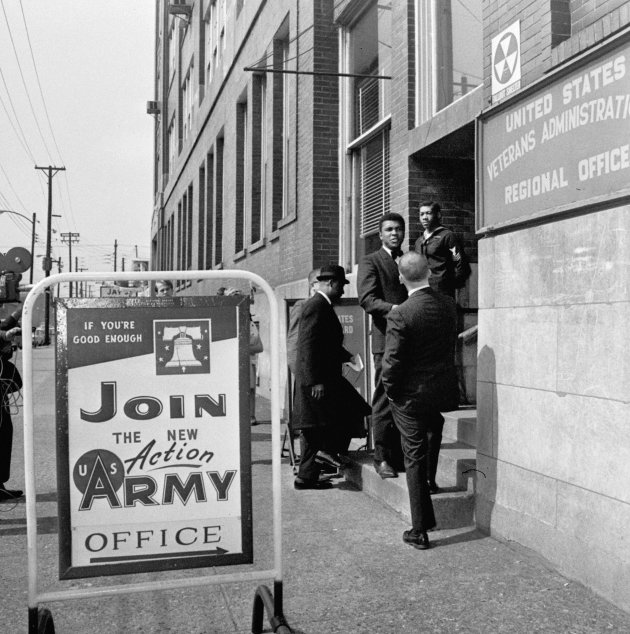
Ali's boxing career came to a screeching halt after that fight. He'd refused induction into the U.S. Army because he stated he was a conscientious objector.
Ali had converted to Islam in 1964 after the first of his two wins over Liston, and changed his name from Cassius Clay. He said Islam was a religion of peace and that he had no desire to engage in combat with those who'd done him or his family no harm.
This all went down at the height of the civil rights movement.
"Shoot them for what?" Ali asked in an interview after he refused induction. "They never called me nigger. They never lynched me. They never put dogs on me. They didn't rob me of my nationality, rape and kill my mother and father. What do I want to shoot them for, for what? Why do I want to go shoot them, poor little people and babies and children and women? How can I shoot them? Just take me to jail."
View gallery
.
Muhammad Ali arrives at the Veterans building to appeal his 1A draft classification. (AP)
He went on trial in Houston on June 20, 1967. The jury deliberated for only 21 minutes before finding him guilty. He was fined $10,000, faced five years in jail and had his passport taken.
He was stripped of the crown and deprived from making a living, but he wasn't silenced. Ali would go on a lecture circuit, speaking at colleges for as little as $1,500 and as much as $10,000.
He desperately needed the money because he wasn't making a lot after being stripped and he was paying an expensive team of attorneys.
Always conscious of his image, Ali joked in one interview that he couldn't allow people to see his car.
"I didn't want people to see the world heavyweight champion driving a Volkswagen, while all them guys were driving their Cadillacs," he said.
At first, there was a lot of tension in the crowds, as opposition to the Vietnam War had only just started. Gradually, though, Ali swung the crowds to his point of view as the country's opinion of the situation in Southeast Asia turned dramatically.
Ali said that on one series of lectures he was set to make $1,500 a speech for talking to students at Canisius, Farleigh Dickinson and C.W. Post. He opened his wife's piggy bank and found, he said, $135, which he needed to buy gas and food for his trip.
Kilroy said that whenever Ali was paid, the first thing he did was find a Western Union.
"Whenever he'd get paid, he'd go send some money to his mother and father so they were OK and then he sent what was left to his wife and kids," Kilroy said.
Despite his financial difficulties, Ali never lost the courage of his convictions. At one of his speeches, he insisted he had no regrets.
While many tried to convince him of the errors of his ways, he remained steadfast and resolute. He told the crowd that sticking for his beliefs led him to come out on top.
"There have been many questions put to me about why I refused to be inducted into the United States Army," Ali said in the speech to students. "Especially, as some have pointed out, as many have pointed out, when not taking the step I will lose so much. I would like to say to the press and those people who think I lost so much by not taking the step, I would like to say I didn't lose a thing up until this very moment. One thing, I have gained a lot. Number one, I have gained a peace of mind. I have gained a peace of heart. I now know I am content with almighty God himself, whose name is Allah. I have also gained the respect of everyone who is here today.
"I have not only gained the respect of everyone who is here today, but worldwide. I have gained respect [from] people all over the world. By taking the step, I would have satisfied a few people who are pushing the war. Even if the wealth of America was given to me for taking the step, the friendship of all of the people who support the war, this would still be nothing [that would] content [me] internally."
The Supreme Court would reverse Ali's conviction in 1971 by an 8-0 vote. But by then, Ali was already back in the ring.
He actually returned from exile in 1970. Georgia didn't have an athletic commission and so he wasn't banned there. He faced Jerry Quarry on Oct. 26 in Atlanta, a fight Ali won via a third-round stoppage.
After one more fight, a knockout of Oscar Bonavena in the 15th round, Ali was ready to face the undefeated Frazier.
According to boxing promoter Bob Arum, the fight nearly took place in Las Vegas, with then-Nevada Governor Paul Laxalt endorsing the fight.
"The bad luck was [when arranging the fight] we stayed at the Desert Inn," Arum told Yahoo Sports.
The Desert Inn was owned by Moe Dalitz, a one-time bootlegger and racketeer who was the most powerful figure in Las Vegas. He was also a reputed mobster.
Dalitz didn't care for Ali because he didn't serve in the war.
He saw Arum and Conrad eating breakfast and asked Conrad why they were there. Dalitz went crazy, Arum said.
"He said, 'I don't want that [expletive] draft dodger in this town,' " Arum said. " 'It's not good for the town.' "
And so the biggest fight in history went not to Las Vegas but to New York a few months later.
View gallery
.
Joe Frazier, left, hits Muhammad Ali during the 15th round of their 1971 title fight. (AP)
It was an epic night that featured scores of celebrities in the crowd. Frank Sinatra was a ringside photographer. Burt Lancaster did color commentary.
It was an outstanding fight, but Frazier's pressure carried the day. He floored Ali in the 15th round with one of the most famous and perfectly executed left hooks in boxing history, sealing the fight.
But Ali would have his days against Frazier, defeating him twice, in a non-title bout on Jan. 28, 1974, in New York, and for the heavyweight title in Manila on Oct. 1, 1975. That was a fight for the ages, remembered as one of a handful of the best in boxing history.
Ali won by 14th-round stoppage when Frazier's trainer, Eddie Futch, asked referee Carlos Padilla to stop the fight. There has long been question about whether Angelo Dundee, then Ali's trainer, would have allowed Ali to go out for the 15th had Futch not stopped it.
In his brilliant 2001 book, "Ghosts of Manila," Mark Kram wrote, "After the press conference, Joe retired to a private villa for rest. He had been sleeping for a couple of hours when George Benton entered with a visitor. The room was dark. 'Who is it?' Joe asked, lifting his head. 'I can't see. Can't see. Turn the lights on.' A light was turned on and he still could not see. Like Ali, he lay there with his veins empty, crushed by a will that had carried him so far and now surely too far. His eyes were iron gates torn up by an explosive. 'Man, I hit him with punches that bring down the walls of a city. What held him up?' He lowered his head for some abstract forgiveness. 'Goddamn it, when somebody going to understand? It wasn't justa fight. It was me and him. Not a fight.' "
Ali wasn't nearly the same fighter after that. He'd taken a fearsome pounding in his second career, after his return from exile. His three fights with Frazier, his 1974 fight with George Foreman in Africa and his 1980 bout with Larry Holmes were particularly brutal.
Ali's win over Foreman became known as "The Rumble in the Jungle," fought in then what was called Zaire and is now the Democratic Republic of the Congo.
He employed his famous "Rope-A-Dope" strategy in that fight. Foreman was a fearsome opponent at the time, the hardest hitter in boxing with a 40-0 record and 39 knockouts.
There were many sportswriters and boxing experts of the day who feared for Ali, such was Foreman's reputation at the time.
"I thought I was going to go in there and just go out and go, 'Boom, boom, boom,' and hit him and get him out of there and then go home," Foreman told Yahoo Sports in 2014. "That was my mistake. This was Muhammad Ali. He was 'The Greatest,' and they called him that because he was, but he was also the smartest. He knew what to do. And he did a great job of it."
Ali no longer had the foot speed or the elusiveness to dance away from Foreman as he'd done with Liston a decade earlier. Instead, he figured out the best strategy was to lay back against the ropes, lean back as far as he could, cover his face with his gloves and as much of his body as he could with his arms and let Foreman pound at him.
Foreman obliged and threw crunching, punishing shots. Ali took them and waited until Foreman became so tired he could no longer raise his arms. When he couldn't, Ali struck back and knocked out Foreman in the eighth round in the most remarkable upset of his career.
"It was my honor to get beaten up by that man," Foreman said, chuckling, in 2014. "I hated him at the time, because I didn't understand. But we grew to love each other. I love him like a brother."
Ali slowed down even more after the win over Frazier and never again looked like the electric, blazing-fast athlete he'd been years earlier.
"Nobody would have beaten Ali prior to the three-and-a-half years he lost [objecting to the Vietnam War]," Arum, who has promoted boxing for 50 years, told Yahoo Sports. "Nobody, and I mean nobody, could have come close to him. He was as fast and as elusive as Sugar Ray Robinson and Sugar Ray Leonard, and he was a heavyweight. His punching power was way better than people gave him credit for, but you never saw it a lot in those days because he was up on his toes moving."
After the Frazier fight, Ali became a personality as much as an athlete. He appeared on CBS' "Face the Nation" in 1976 during the Ford-Carter presidential race. He was asked whom he favored, and he declined to answer, saying he didn't know enough and didn't want to influence people who followed him and would vote for whomever he would say.
He officially retired from boxing in 1981 after a unanimous decision loss to Trevor Berbick, ending his career with a 55-5 record. He remains the only three-time lineal heavyweight champion, having won titles in 1964, '74 and '78.
As he aged, Ali began to think of his role in the world and what he could do to improve it. And he talked on "Face the Nation" about his desire to do charitable acts.
"We only have so many hours a day to do what we have to do, so many years to live, and in those years, we sleep about eight hours a day," Ali sad. "We travel. We watch television. If a man is 50 years old, he's lucky if he's actually had 20 years to actually live. So I would like to do the best I can for humanity.
"I'm blessed by God to be recognized as the most famous face on the Earth today. And I cannot think of nothing better than helping God's creatures or helping poverty or good causes where I can use my name to do so."
In a 1975 interview with Playboy that was released around the time of his third fight with Frazier, he spoke of how his view of the world had changed.
He said it was his responsibility to take advantage of his notoriety by helping his fellow man.
"You listen up and maybe I'll make you as famous as I made Howard Cosell," he said in the Playboy interview. "Wars on nations are fought to change maps, but wars on poverty are fought to map change. The man who views the world at 50 the same as he did at 20 has wasted 30 years of his life.
"These are words of wisdom, so pay attention, Mr. Playboy. The man who has no imagination stands on the Earth. He has no wings, he cannot fly. When we are right, no one remembers, but when we are wrong, no one forgets."
Kilroy, King and Arum said they knew of many charitable acts Ali had done. Kilroy said Ali, who was the most popular athlete in the world for years and commanded attention everywhere he went, would always be willing to do charitable acts, but said he didn't want cameras or reporters around because he didn't want anyone to think he was doing it for the publicity.
In 1973, for example, Ali learned that a home for elderly Jewish people was going to close because it was out of money.
"I'll never forget that night," Kilroy said. "It was a cold January night and we saw it on the news. Ali really paid attention to it and you could tell it bothered him, that all these people were going to be put out. They had nowhere to go. He told me to find out where it was, so I called the TV station and got the address.
"We drove over there and walked in and some guy comes up to me. I said, 'We're looking for the man in charge. Where is he?' And the guy says, 'I am. What do you want?' And Ali tells him he wants to help. He wrote him a check for $200,000 and tells him to put it in the bank that night. And then he writes another check for $200,000 and tells him to wait four days, because he has to get home and put some more money in the bank to cover the check."
View gallery
.
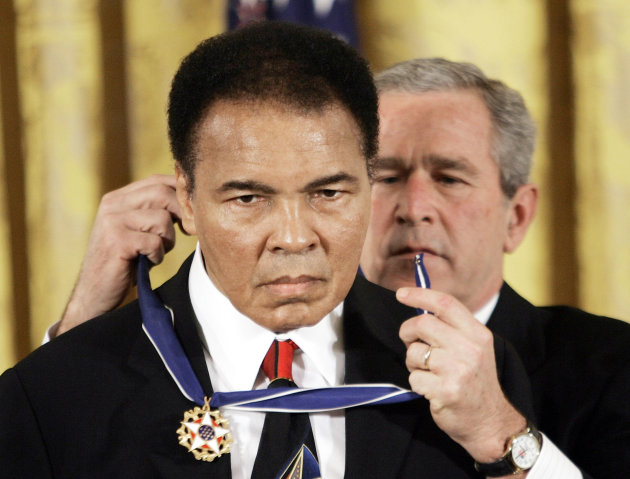
President Bush presents the Presidential Medal of Freedom to Muhammad Ali in 2005. (AP)
In 1990, shortly before the first Gulf War between the U.S. and Iraq, he flew to Baghdad to speak with Saddam Hussein to secure the release of 15 U.S. hostages.
Hussein agreed to release the hostages.
For the rest of his life Ali worked to promote the cause of peace and charity. In December 2015, he condemned ISIS and took a shot at Republican presidential candidate Donald Trump (without mentioning Trump's name) when Trump suggested temporarily banning all Muslims from entering the U.S.
After the terrorist shootings in San Bernardino, Ali released a statement through his publicist. The headline said, "Statement From Muhammad Ali Regarding Presidential Candidates Proposing to Ban Muslim Immigration to the United States."
"I am a Muslim and there is nothing Islamic about killing innocent people in Paris, San Bernardino or anywhere else in the world," Ali said in the statement. "True Muslims know that the ruthless violence of so-called Islamic Jihadists goes against the very tenets of our religion.
"We as Muslims have to stand up to those who use Islam to advance their own personal agenda. They have alienated many from learning about Islam. True Muslims know or should know that it goes against our religion to try and force Islam on anybody.
"Speaking as someone who has never been accused of political correctness, I believe that our political leaders should use their position to bring understanding about the religion of Islam and clarify that these misguided murderers have perverted people's views on what Islam really is."
It's the last major public statement Muhammad Ali ever made.

Monday, May 23, 2016

BARCELONA WINS COPA DEL REY CUP BY 2-0

Ten-man Barcelona secured a second straight domestic double with a 2-0 extra-time victory over Sevilla in the Copa del Rey final on Sunday. Jordi Alba put Barca ahead and Neymar sealed the win in the dying moments.
La Liga champions Barca had to play the majority of regulation time a man down after center back Javier Mascherano was sent off in the 36th minute. Sevilla, this season's Europa League winners, failed to capitalize on their numerical superiority and themselves had midfielder Ever Banega dismissed in second half added time.
Spain left back Alba broke the deadlock in the 112th edition of the competition when he raced onto a Lionel Messi pass in the 97th minute of an ill-temperered contest and clipped an angled shot past Sevilla goalkeeper Sergio Rico. Sevilla defender Daniel Carrico then lost his head and was sent off moments before Messi sent Neymar clear to stroke in Barca's second.
It was a record-extending 28th Cup triumph for Barcelona and their seventh domestic double, while Sevilla were denied a sixth Cup success.
Still mighty without Mascherano
With Spanish King Felipe VI watching from the stands at Atletico Madrid's Calderon stadium, Barcelona took control in the early stages as expected and got their first real sight of goal in the eighth minute. Andres Iniesta chipped a pass over the Sevilla defence for Luis Suarez but he hooked his shot wastefully wide.
Vitolo created a good chance for Coke, who scored twice in the Europa League final, in the 17th minute but the Sevilla captain failed to connect cleanly.
A drab match burst into life in the 36th minute when Mascherano was shown a straight red for hauling Kevin Gameiro back when he was through on goal. Banega sent the resulting freekick arrowing towards the top corner but Barcelona keeper Marc-Andre ter Stegen pulled off an acrobatic fingertip save.
Suarez sidelined
Sevilla began the second period strongly and Banega’s 50th-minute effort was deflected onto the inside of a post by Gerard Pique.
Barcelona’s woes deepened in the 57th minute when top scorer Suarez had to come off with what looked like a hamstring strain and was replaced by Rafinha. Uruguay forward Suarez, who broke down in tears on the bench, ended a stellar season with 59 goals in 53 matches in all competitions.
Now it was Sevilla dominating possession and Barcelona having to bide their time and wait for a chance to break quickly. Messi tested Rico with a freekick in the 77th minute and Gameiro was denied by a fine Pique block two minutes later.
Banega levels the playing field
The final stages of regulation time were disrupted by a slew of fouls and yellow cards on both sides before Banega hacked down Neymar when he was poised to gallop clear and was sent off. Tempers were fraying and Vicente Iborra was booked for a reckless lunge on Ter Stegen before the referee blew for extra time.
Barcelona finished much the stronger and the final whistle prompted wild celebrations among the Barca players and fans, while the Sevilla support applauded their tearful heroes for their efforts.
Barcelona's latest success under coach Luis Enrique capped a fine season, although the Catalan giants were denied another European crown by La Liga rivals Atletico Madrid.

Saturday, May 21, 2016

MANNY PACQUIAO WINS SENATE SEAT IN THE PHILIPINES

Filipino boxing great Manny Pacquiao holds his Certificate of Canvass as he is proclaimed the seventh senator by Commissioner Christopher Lim (right) in a ceremony Thursday.
On Thursday, boxing great Manny "Pacman" Pacquiao stood before a cheering crowd and flashing cameras, his arm hoisted above his head. The "people's champion" was a winner once again.
Only this time, he hadn't won a boxing title, but a Senate seat in his home country of the Philippines. The political victory brings the 37-year-old, who had previously served in the Philippines' House of Representatives, ever closer to an eventual shot at the presidency.
"The Filipino slugger garnered more than 16 million votes, landing 7th among 12 new members of the Senate, a traditional springboard to the presidency," The Associated Press reports, adding that Pacquiao demurred when asked about his future political ambitions.
Judging by his popularity in his country, the presidency could be well within his reach.
"In the Philippines, I would say Pacquiao is like Elvis meets Justin Bieber, meets Michael Jordan, meets Bill Clinton," Ryan Songalia, a N.Y.-based Filipino journalist, told NPR in 2011.
By the time of the next presidential election, in 2022, Pacquiao will be old enough to run for the nation's highest office. (Candidates must be at least 40.) He served as a representative for the southern Sarangani province starting in 2010, saying he wanted to help improve the lives of poor people in his country.
"In my province — Sarangani province — the population is more than half-a-million and we don't have a hospital ... imagine that," Pacquiao told NPR in 2011.
He was roundly criticized, however, for prioritizing his boxing career over his legislative duties. Last year, the Chicago Tribune reported: "Congressional records show that during his first term in 2010-2013, Pacquiao was 'actually present' for 98 out of 168 session days, and only for four days [in 2014]."
So when the boxer mentioned his possible participation in this summer's Olympic Games in Rio during the proclamation ceremony for his Senate win, he said it would depend on the will of the people.
"I need to ask if the Filipino people will allow me to compete in the Olympics, Pacquiao said, according to a video from The Guardian, though he announced earlier this year that he was retired. "I need to study it first, and we are seeking the approval of the Filipino people."
Pacquiao also faced criticism earlier this year as well when he said that people in same-sex relationships are "worse than animals." While he apologized for the comparison, he emphasized that he still opposed same-sex marriage. Pacquiao, who is a born-again Christian, told LGBT people that he was "praying for [them]."
However, as this superb Guardian profile on Pacquiao says, he "once was not so righteous." It says:
"He once was an all-night hound dog, taking his pleasure where he pleased, ignoring all advice to respect the sanctity of his marriage vows and determined to squeeze as much fun from life as was available to someone who was born into grinding poverty. Those were his hardcore inclinations until only a few years ago."
After Pacquiao said he "heard the voice of God," he changed his ways, dedicating himself to his family, boxing and, now, politics. And the Christian politician also won the endorsement of Rodrigo Duterte, the president-elect of the overwhelmingly Catholic country.
Duterte made headlines earlier this year when he "apparently joked about a rape and murder in 1989, commenting that the victim was beautiful and as mayor he 'should have been first' when men took turns raping her," as the Two-Way reported.
"He said his statement was not making fun of rape, but he did not retract it or apologize for it.
" 'It was said in anger; I was not joking,' he said by way of clarification, according to the AP. 'I said, "This one, she's beautiful, like an actress, son of a bitch they beat me to her. Kill them all." ' "