Muhammad Ali, the eloquent, colorful, controversial and brilliant three-time heavyweight boxing champion who was known as much for his social conscience and staunch opposition to the Vietnam War as for his dazzling boxing skills, died Friday.
Ali, who had a long battle with Parkinson's disease, was taken to a Phoenix area hospital earlier this week where he was being treated for a respiratory issue. He was 74.
Once the most outrageous trash talker in sports, he was largely muted for the last quarter century of his life, quieted by a battle with Parkinson's.
Born Cassius Marcellus Clay Jr. on Jan. 17, 1942, in Louisville, Ky., Ali learned to box after his bicycle was stolen when he was 12 years old. When young Clay vowed to "whoop the behind" of the thief, a local police officer encouraged him to learn to box to channel his energy.
He would go on to become known as "The Greatest," and at his peak in the 1970s was among the most recognizable faces on Earth.
He was known for his tendency to recite poems while making predictions about his fights – "Float like a butterfly, sting like a bee. The hands can't hit what the eyes can't see." – as well as for giving opponents often unflattering nicknames. He referred to Sonny Liston as "the big ugly bear," George Chuvalo as "The Washerwoman," Floyd Patterson as "The Rabbit" and Earnie Shavers as "The Acorn."
But his most controversial, and some would say cruel, nicknames were reserved for his fiercest rival, Joe Frazier. He first dubbed Frazier "Uncle Tom" and then later called him "The Gorilla."
When Ali prepared to meet Frazier for a third time in Manila, Philippines, on Oct. 1, 1975, he frequently carried a toy rubber gorilla with him. At one news conference, he pulled the gorilla out of his pocket and began punching it as he said, "It's going to be a killa and a thrilla and a chilla when I get the gorilla in Manila."
Frazier, though, took it personally and harbored a decades-long grudge.
"It sure did bother him," Gene Kilroy, Ali's friend for more than 50 years, told Yahoo Sports.
Kilroy said Ali was simply promoting the fights and meant no harm, and said Ali regretted the impact his words had upon Frazier.
"I used to tell Ali, 'Someday, me, you and Joe are going to be three old men sitting in the park laughing about all that [expletive],' " Kilroy recalled. "And Ali said, 'That would be great!' I talked to Joe and Joe said, 'No, [expletive] him. I don't want to be with him.' But he loosened up later and they mended fences."
Not long before Frazier's death in 2011, he attended an autograph signing and memorabilia show in Las Vegas. Frazier grabbed a copy of an old Sports Illustrated magazine that had a photo of the two fighters and promoter Don King on the cover.
"Man," he said, sounding wistful, "we gave the people some memories, me and Ali."
Ali was at the peak of his professional powers after knocking out Zora Folley in New York on March 22, 1967. He battered Folley throughout and stopped him in the seventh.
After the bout, Folley shared his thoughts with Sports Illustrated.
"The right hands Ali hit me with just had no business landing – but they did. They came from nowhere," Folley said. "… He's smart. The trickiest fighter I've seen. He's had 29 fights and acts like he's had a hundred. He could write the book on boxing, and anyone that fights him should be made to read it first."
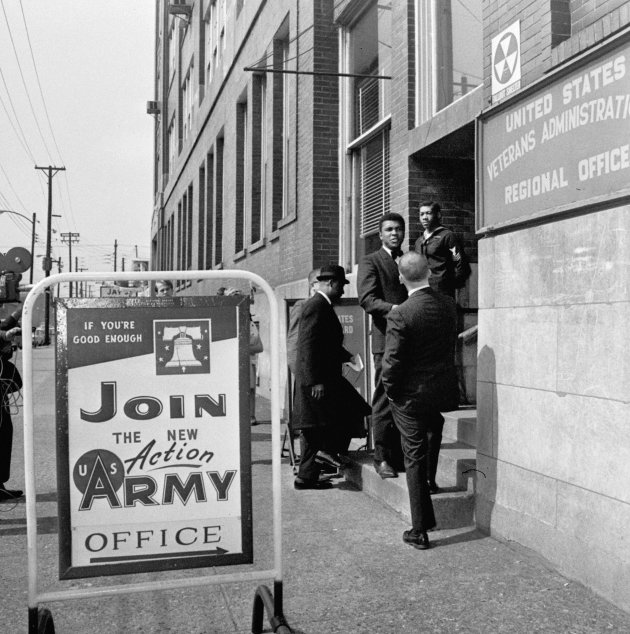
Ali's boxing career came to a screeching halt after that fight. He'd refused induction into the U.S. Army because he stated he was a conscientious objector.
Ali had converted to Islam in 1964 after the first of his two wins over Liston, and changed his name from Cassius Clay. He said Islam was a religion of peace and that he had no desire to engage in combat with those who'd done him or his family no harm.
This all went down at the height of the civil rights movement.
"Shoot them for what?" Ali asked in an interview after he refused induction. "They never called me nigger. They never lynched me. They never put dogs on me. They didn't rob me of my nationality, rape and kill my mother and father. What do I want to shoot them for, for what? Why do I want to go shoot them, poor little people and babies and children and women? How can I shoot them? Just take me to jail."
He went on trial in Houston on June 20, 1967. The jury deliberated for only 21 minutes before finding him guilty. He was fined $10,000, faced five years in jail and had his passport taken.
He was stripped of the crown and deprived from making a living, but he wasn't silenced. Ali would go on a lecture circuit, speaking at colleges for as little as $1,500 and as much as $10,000.
He desperately needed the money because he wasn't making a lot after being stripped and he was paying an expensive team of attorneys.
Always conscious of his image, Ali joked in one interview that he couldn't allow people to see his car.
"I didn't want people to see the world heavyweight champion driving a Volkswagen, while all them guys were driving their Cadillacs," he said.
At first, there was a lot of tension in the crowds, as opposition to the Vietnam War had only just started. Gradually, though, Ali swung the crowds to his point of view as the country's opinion of the situation in Southeast Asia turned dramatically.
Ali said that on one series of lectures he was set to make $1,500 a speech for talking to students at Canisius, Farleigh Dickinson and C.W. Post. He opened his wife's piggy bank and found, he said, $135, which he needed to buy gas and food for his trip.
Kilroy said that whenever Ali was paid, the first thing he did was find a Western Union.
"Whenever he'd get paid, he'd go send some money to his mother and father so they were OK and then he sent what was left to his wife and kids," Kilroy said.
Despite his financial difficulties, Ali never lost the courage of his convictions. At one of his speeches, he insisted he had no regrets.
While many tried to convince him of the errors of his ways, he remained steadfast and resolute. He told the crowd that sticking for his beliefs led him to come out on top.
"There have been many questions put to me about why I refused to be inducted into the United States Army," Ali said in the speech to students. "Especially, as some have pointed out, as many have pointed out, when not taking the step I will lose so much. I would like to say to the press and those people who think I lost so much by not taking the step, I would like to say I didn't lose a thing up until this very moment. One thing, I have gained a lot. Number one, I have gained a peace of mind. I have gained a peace of heart. I now know I am content with almighty God himself, whose name is Allah. I have also gained the respect of everyone who is here today.
"I have not only gained the respect of everyone who is here today, but worldwide. I have gained respect [from] people all over the world. By taking the step, I would have satisfied a few people who are pushing the war. Even if the wealth of America was given to me for taking the step, the friendship of all of the people who support the war, this would still be nothing [that would] content [me] internally."
The Supreme Court would reverse Ali's conviction in 1971 by an 8-0 vote. But by then, Ali was already back in the ring.
He actually returned from exile in 1970. Georgia didn't have an athletic commission and so he wasn't banned there. He faced Jerry Quarry on Oct. 26 in Atlanta, a fight Ali won via a third-round stoppage.
After one more fight, a knockout of Oscar Bonavena in the 15th round, Ali was ready to face the undefeated Frazier.
According to boxing promoter Bob Arum, the fight nearly took place in Las Vegas, with then-Nevada Governor Paul Laxalt endorsing the fight.
"The bad luck was [when arranging the fight] we stayed at the Desert Inn," Arum told Yahoo Sports.
The Desert Inn was owned by Moe Dalitz, a one-time bootlegger and racketeer who was the most powerful figure in Las Vegas. He was also a reputed mobster.
Dalitz didn't care for Ali because he didn't serve in the war.
He saw Arum and Conrad eating breakfast and asked Conrad why they were there. Dalitz went crazy, Arum said.
"He said, 'I don't want that [expletive] draft dodger in this town,' " Arum said. " 'It's not good for the town.' "
And so the biggest fight in history went not to Las Vegas but to New York a few months later.
It was an epic night that featured scores of celebrities in the crowd. Frank Sinatra was a ringside photographer. Burt Lancaster did color commentary.
It was an outstanding fight, but Frazier's pressure carried the day. He floored Ali in the 15th round with one of the most famous and perfectly executed left hooks in boxing history, sealing the fight.
But Ali would have his days against Frazier, defeating him twice, in a non-title bout on Jan. 28, 1974, in New York, and for the heavyweight title in Manila on Oct. 1, 1975. That was a fight for the ages, remembered as one of a handful of the best in boxing history.
Ali won by 14th-round stoppage when Frazier's trainer, Eddie Futch, asked referee Carlos Padilla to stop the fight. There has long been question about whether Angelo Dundee, then Ali's trainer, would have allowed Ali to go out for the 15th had Futch not stopped it.
In his brilliant 2001 book, "Ghosts of Manila," Mark Kram wrote, "After the press conference, Joe retired to a private villa for rest. He had been sleeping for a couple of hours when George Benton entered with a visitor. The room was dark. 'Who is it?' Joe asked, lifting his head. 'I can't see. Can't see. Turn the lights on.' A light was turned on and he still could not see. Like Ali, he lay there with his veins empty, crushed by a will that had carried him so far and now surely too far. His eyes were iron gates torn up by an explosive. 'Man, I hit him with punches that bring down the walls of a city. What held him up?' He lowered his head for some abstract forgiveness. 'Goddamn it, when somebody going to understand? It wasn't justa fight. It was me and him. Not a fight.' "
Ali wasn't nearly the same fighter after that. He'd taken a fearsome pounding in his second career, after his return from exile. His three fights with Frazier, his 1974 fight with George Foreman in Africa and his 1980 bout with Larry Holmes were particularly brutal.
Ali's win over Foreman became known as "The Rumble in the Jungle," fought in then what was called Zaire and is now the Democratic Republic of the Congo.
He employed his famous "Rope-A-Dope" strategy in that fight. Foreman was a fearsome opponent at the time, the hardest hitter in boxing with a 40-0 record and 39 knockouts.
There were many sportswriters and boxing experts of the day who feared for Ali, such was Foreman's reputation at the time.
"I thought I was going to go in there and just go out and go, 'Boom, boom, boom,' and hit him and get him out of there and then go home," Foreman told Yahoo Sports in 2014. "That was my mistake. This was Muhammad Ali. He was 'The Greatest,' and they called him that because he was, but he was also the smartest. He knew what to do. And he did a great job of it."
Ali no longer had the foot speed or the elusiveness to dance away from Foreman as he'd done with Liston a decade earlier. Instead, he figured out the best strategy was to lay back against the ropes, lean back as far as he could, cover his face with his gloves and as much of his body as he could with his arms and let Foreman pound at him.
Foreman obliged and threw crunching, punishing shots. Ali took them and waited until Foreman became so tired he could no longer raise his arms. When he couldn't, Ali struck back and knocked out Foreman in the eighth round in the most remarkable upset of his career.
"It was my honor to get beaten up by that man," Foreman said, chuckling, in 2014. "I hated him at the time, because I didn't understand. But we grew to love each other. I love him like a brother."
Ali slowed down even more after the win over Frazier and never again looked like the electric, blazing-fast athlete he'd been years earlier.
"Nobody would have beaten Ali prior to the three-and-a-half years he lost [objecting to the Vietnam War]," Arum, who has promoted boxing for 50 years, told Yahoo Sports. "Nobody, and I mean nobody, could have come close to him. He was as fast and as elusive as Sugar Ray Robinson and Sugar Ray Leonard, and he was a heavyweight. His punching power was way better than people gave him credit for, but you never saw it a lot in those days because he was up on his toes moving."
After the Frazier fight, Ali became a personality as much as an athlete. He appeared on CBS' "Face the Nation" in 1976 during the Ford-Carter presidential race. He was asked whom he favored, and he declined to answer, saying he didn't know enough and didn't want to influence people who followed him and would vote for whomever he would say.
He officially retired from boxing in 1981 after a unanimous decision loss to Trevor Berbick, ending his career with a 55-5 record. He remains the only three-time lineal heavyweight champion, having won titles in 1964, '74 and '78.
As he aged, Ali began to think of his role in the world and what he could do to improve it. And he talked on "Face the Nation" about his desire to do charitable acts.
"We only have so many hours a day to do what we have to do, so many years to live, and in those years, we sleep about eight hours a day," Ali sad. "We travel. We watch television. If a man is 50 years old, he's lucky if he's actually had 20 years to actually live. So I would like to do the best I can for humanity.
"I'm blessed by God to be recognized as the most famous face on the Earth today. And I cannot think of nothing better than helping God's creatures or helping poverty or good causes where I can use my name to do so."
In a 1975 interview with Playboy that was released around the time of his third fight with Frazier, he spoke of how his view of the world had changed.
He said it was his responsibility to take advantage of his notoriety by helping his fellow man.
"You listen up and maybe I'll make you as famous as I made Howard Cosell," he said in the Playboy interview. "Wars on nations are fought to change maps, but wars on poverty are fought to map change. The man who views the world at 50 the same as he did at 20 has wasted 30 years of his life.
"These are words of wisdom, so pay attention, Mr. Playboy. The man who has no imagination stands on the Earth. He has no wings, he cannot fly. When we are right, no one remembers, but when we are wrong, no one forgets."
Kilroy, King and Arum said they knew of many charitable acts Ali had done. Kilroy said Ali, who was the most popular athlete in the world for years and commanded attention everywhere he went, would always be willing to do charitable acts, but said he didn't want cameras or reporters around because he didn't want anyone to think he was doing it for the publicity.
In 1973, for example, Ali learned that a home for elderly Jewish people was going to close because it was out of money.
"I'll never forget that night," Kilroy said. "It was a cold January night and we saw it on the news. Ali really paid attention to it and you could tell it bothered him, that all these people were going to be put out. They had nowhere to go. He told me to find out where it was, so I called the TV station and got the address.
"We drove over there and walked in and some guy comes up to me. I said, 'We're looking for the man in charge. Where is he?' And the guy says, 'I am. What do you want?' And Ali tells him he wants to help. He wrote him a check for $200,000 and tells him to put it in the bank that night. And then he writes another check for $200,000 and tells him to wait four days, because he has to get home and put some more money in the bank to cover the check."
In 1990, shortly before the first Gulf War between the U.S. and Iraq, he flew to Baghdad to speak with Saddam Hussein to secure the release of 15 U.S. hostages.
Hussein agreed to release the hostages.
For the rest of his life Ali worked to promote the cause of peace and charity. In December 2015, he condemned ISIS and took a shot at Republican presidential candidate Donald Trump (without mentioning Trump's name) when Trump suggested temporarily banning all Muslims from entering the U.S.
After the terrorist shootings in San Bernardino, Ali released a statement through his publicist. The headline said, "Statement From Muhammad Ali Regarding Presidential Candidates Proposing to Ban Muslim Immigration to the United States."
"I am a Muslim and there is nothing Islamic about killing innocent people in Paris, San Bernardino or anywhere else in the world," Ali said in the statement. "True Muslims know that the ruthless violence of so-called Islamic Jihadists goes against the very tenets of our religion.
"We as Muslims have to stand up to those who use Islam to advance their own personal agenda. They have alienated many from learning about Islam. True Muslims know or should know that it goes against our religion to try and force Islam on anybody.
"Speaking as someone who has never been accused of political correctness, I believe that our political leaders should use their position to bring understanding about the religion of Islam and clarify that these misguided murderers have perverted people's views on what Islam really is."
It's the last major public statement Muhammad Ali ever made.